Thursday, March 24, 2016

War is an implacable beauty.


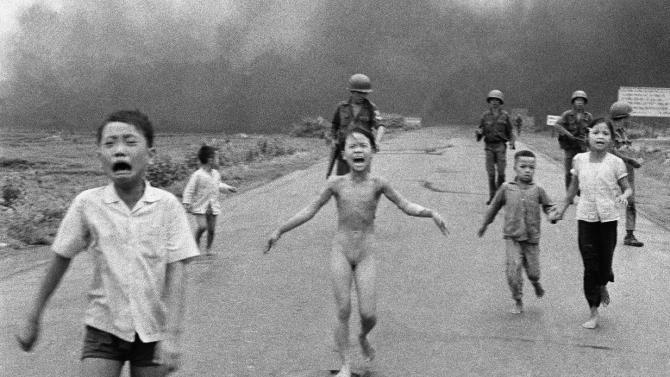
War is an implacable beauty. The fact that humans have the ability level everything in a 6 mile radius with an object that could be transported in a U-Haul truck, astonishes me. The inexplicable enormity of the destruction that a nuclear bomb is capable leaves anyone who is lucky enough to witness it, in awe. A napalm bomb is just the same. Once dropped, it causes what looks to be a carpet of red and orange engulfing anything in range in a gorgeous spectacle of what looks like smoke and fire engaging in a bare knuckle brawl.
These are the beautiful parts of war. What makes their beauty implacable, is the pure agony and suffering it causes humans. If you were to listen to screams of men, women, and children slowly burning to death under that beautiful carpet of flame, it would shake you to your soul. This is what makes the beauty of war implacable. Devices that cause this severity of suffering, or that can decimate entire populations of innocent humans, have no place in our society, no matter how beautiful they are.

Wednesday, March 23, 2016

War is a clash of differing and shifting perceptions.


War is a clash of differing and shifting perceptions. Differences are a part of human nature. No two people are identical, and likewise no two cultures are identical. Our differences, however, are not the problem. It is our inability to see value in the uniqueness of others, the inability to accept something that is not our own, and the inability to see another way of life as equal to ours. War arises from these discrepancies of lifestyle. The image above shows a pair of eyes. In the left eye the images are black and white. They depict the harsh reality of the war. Each image shows pain, destruction, and loss caused by war. In the right eye, the images are bright and full of color. Similar to the left eye, they show images of war. These images, though, are not the same. They are joyful and light. They show moments of war, that although shown often in today’s media, are more uncommon than the ones in the left eye. Both eyes are looking at the concept of war but they are perceiving two completely different things. Neither one can be said to be more “correct” because each is true in its own way. Each eye, though, sees only part of the war rather than the whole thing. The only way for the war to be fully understood is by looking through both eyes, through both perspectives. It is learning to accept that a difference in thinking is okay and that neither side is more “correct” than the other that we will end the war. The pupils of the eyes, which contain the images, are round. They exemplify the repetitiveness of war. Throughout American history, hundreds of wars have been fought, many of them for similar causes with similar outcomes. In each war countless men and women have lost their lives, cities have been destroyed, and families have been torn apart.

War is Despair


https://www.pinterest.com/pin/426153183465636670/

War is about despair because soldiers experience hopelessness in the face of the deaths of their fellow soldiers. At the start of the war, soldiers are hopeful and energized at the thought of going to war with the full support of their brothers in arms. But as the war progresses, they start losing comrades as well as hope every time one of them dies. They cannot make sense of why one person dies and another lives. After a while when they start realizing that they may not be able to go home, they get angry and despondent. The sight of their fallen fellow soldiers consumes their every thought of whether they are going to die or not. The shock of seeing a friend get blown up, forces one to spiral into a pit of despair. In this picture, the surviving soldier is sitting on a damaged cannon unable to cope with the fact that his friend just got killed. His face is in his hands because he is asking “why him and not me?”. One can see that at the bottom of the picture the surviving soldiers hat is on the ground depicting a sense of anger and frustration at the reality of war. This soldier is taking time to commemorate his brother in war by observing a moment of silence.


War is Camaraderie


War is about camaraderie because it binds the soldiers with a common experience. The military serves as a surrogate family. The soldiers eat together, sleep together, smoke together, and fight in trenches together. Spending hours with each other, helps to form a type of bond that only one could gain through life or death fighting situations. They have put their lives in each other's hands ever since day one of boot camp when they had to learn to work as a unit in order to complete their daily mission. They came into boot camp not knowing anything about each other’s strengths or weaknesses. From there, they were stripped of all things that separated them and given the same uniform in order to instill unity. Going into the war, they now had the familiarity and trust that a unit needed to be successful on missions. This picture is of my grandfather lying on crates of C- rations. As you can see, he is able to goof around with his friends even in times of war. The shadow at the bottom of the picture indicates that my grandfather had friends who cared enough to share his memories of the war. The tents in the background show how they slept as brothers. The largest tent shown in the picture was of their mess hall where they shared all their meals together. My grandfather is smoking a cigarette, a common outlet to socialize with others. Although he is alone in the picture, he is never alone because his band of brothers are always with him, giving him support, encouragement, and friendship.

War is something that molded our past but doesn't have to shape our future.

History tends to repeat itself when we don't learn lessons from the past. Albert Einstein once said, “Insanity: doing the same thing over and over again and expecting different results.” By this definition, most world governments are insane. Most world leaders will resort to war to solve their problems. Why change this ritual if it has brought power and wealth to our society?  War is a power struggle with the desire to have the “upper hand”. The people of this nation choose who is put into power. Shouldn’t we the people decide, then, what actions the powerful take on our behalf? Is possession of power and wealth worth the death and destruction that war brings?  

The picture shown above shows the cost of war. We see tragic events on the news but don't see all of the ways they affect people. We cannot feel true empathy for those who died in the war and for their families. Those who experience this loss must cling to the hope that their loved ones did not die in vain. But what if soldiers never had to fight? The necessity of war is an illusion. There's only one way to change it: stop the fighting and killing and learn to work out our problems peacefully.  War doesn't have to be the solution of the future. The above photo is powerful because of the truth that lies within it. The mirrors give an illusion of many dead bodies, while only 12 were actually dead. This illusion illustrates something that hasn't occurred yet but is bound to if we don't apply lessons we have to learned from the past to create a better, more peaceful future.

Bibliography:
 Green, Tyler. "Tyler Green Modern Art Notes." The Flag: David Rubin Picks Sam Wiener. Mordern Art Notes. Web. 23 Mar. 2016. 

War is justified as a necessary evil. I have never seen it. Those who have seen it will never forget it.

War. World governments justify it as a necessary evil. Our government makes our society believe that maintaining power through acts of war is necessary to sustain our freedom. While I have seen movies and read books about war, I have never experienced firsthand the trauma that war creates; therefore, war itself hasn't made a dramatic impression on my own life. My friends and I will talk about the sports game played the previous night but not the house that exploded three doors down from us.  Why? Because the house three doors down from us is still standing. But this may not be the case for the families living in the war-torn areas. Those who have experienced life in the areas devastated by war will never forget the horror that is war.

The picture shown above of a soldier with a tear streaming down his face gives a silent insight into the hidden costs of war. We can relate to the soldier in a sense that we all have experienced fear, loss, and regret. Although we can relate to the emotions of a soldier, those who haven't put on a uniform cannot relate to the source of the emotions soldiers experienced as a result of war. We think of soldiers as tough, “be all you can be” heroes. We see them going off to war as a young, unbreakable, idealistic individuals.  In reality, they are all just like we are — human. When soldiers return from war, perhaps they are broken in more ways than we will ever know.

Bibliography:
Glass, Brandon. "CRYING SOLDIER." Flickr. Yahoo! Web. 23 Mar. 2016.
 

War is Sacrifice


War is about sacrifice because one is willing to give up creature comforts, leave one’s family, and fight for the ideals for their country. Although a soldier may miss such amenities as indoor plumbing, it is a small sacrifice that he is willing to endure for a short period of time. Leaving one’s family to serve in the military would be a tough ordeal, but it is a risk one is willing to take. The duty that one feels for their country propels them to enlist in order to accomplish a greater good. This picture is of my grandfather who served in the Korean War in 1951. He is smiling because he knows that his presence is honoring for his family and country. As you can see, there are clothes hanging on the tent support line. There are no washing machines or dryers, which are some of the comforts of home. He is wearing his dog tags knowing that someday it may be used to identify his corpse.  His army fatigues also show that he has joined a brotherhood that is now fighting for the same cause. He is willing to endure even the inclement weather as shown by his rolled up shirt. I am sure that the gold bracelet on his right wrist was a constant reminder of the loved ones he left behind.


War is a paradox of weakness creating power and power creating weakness.


The photo above shows a group of Vietnam War veterans protesting through the streets with a sign that reads “We Won’t Fight Another Rich Man’s War!!!”  The Vietnam War, along with many other wars, brings to light the subject of classism: those being sent to fight the war versus those who were making the decisions. War is deceiving. We assume that our government makes us powerful, but in reality we make the government powerful. In turn, the government uses that power to control its citizens. Many soldiers have no say in the decision of whether or not to go to war, and the true intention of war is hidden from them.  Likewise, the government typically claims its intentions for war are to spread democracy and liberty, while, often, the true motivations are economic advances. For instance, the motive behind intervening in Vietnam during the Vietnam War is constantly debated. Most believe the US got involved in the Vietnam War to prevent communism from ruining the country in the same manner as the system had in China. On the other hand, it is more likely that the government intervened for more self-serving reasons. The government wanted war, and, therefore, our soldiers went off to Vietnam.
Looking back at the photo of the Vietnam veterans protesting in the street, one begins to sympathize with those who suffered in the war. The Vietnam War was unfair because the rich and powerful could exempt their sons from the draft, while poor young men had no choice but to follow orders and fight a war they didn’t believe in. How a government uses the power it gains off the backs of its citizens often demonstrates the weakness of a “bully” mentality. The government uses war to maintain power instead of using power to create peace.

Bibliograohy: 
Sverdrupian. ""We Won't Fight Another Rich Man's War!!!" - Vietnam Veterans Against the War, circa 1970." Imgur. Sverdrupian. Web. 23 Mar. 2016.
 

War isn't hell, war is worse.


War isn't hell, war is worse. If someone is condemned to hell it is because they have done something wrong. In war you always have innocent bystanders who are killed simply for being in the wrong place at the wrong time. Since the conflict in Syria has started, 210,000 civilians have been killed, while 1.5 million have been injured, and 10.9 million people displaced as a result of the war. It is estimated that 20-25% of deaths are children. Kids who have not even lived long enough to have done something wrong, are victims of war. 1.2 million homes, 36% of hospitals, and 4,000 schools have been destroyed by bombings. Innocent bystanders are losing basic necessities through no fault of their own. These civilians have been put in hell because of a war between four groups trying take control of the country, something they have no control over. The crisis in Syria is only one example of how war can impose it’s hellish conditions to those who do not deserve it. The only thing the innocent bystanders have done wrong to have earned their place in that hell is simply being in the wrong place at the wrong time.

War is evolving.

War in America has evolved with time. It started with the revolutionary war. This country was founded on the backs of the revolutionaries who were willing to make the ultimate sacrifice for something they valued more than life itself: freedom for themselves, and the generations to follow. They fought for this freedom with guns and cannons; with their lives.
When declaring our independence from Britain, we stated that “All men are created equal” and that “we hold these truths to be self evident.” When examining history we see many cases where the opposite is shown. Looking at the civil rights movement, we see an example of how war has indeed evolved. The Civil Rights Movement was caused because certain groups of people who were given less freedoms than those of different skin color, even though they were created equally to them. It does not make logical sense to restrict the freedoms of a group of people who are considered equal by the document that founded the ideals of this country. They saw this injustice, but they did not grab their guns and go to fight a battle. Instead, they rallied together and marched for their freedom. Their guns were picket signs, their cannons were rallies, their most powerful weapon was being able to come together. The movement had a good idea and that’s what got people from all walks of life on board: equal rights for all Americans.
These wars fought with the same ideals in mind, just with different weapons.

War is the filth of man


While war does bring out the true person, sometimes it isn't the person we want to see. This person will do unthinkable things to other. Some of which I have shown in the picture above. This is especially because they are in the cover of war. The cover of war allows a person to do whatever they want without much consequence. In The Thing They carried this is especially shown when Rat Kiley butchers the water buffalo. Also when Kiowa strapped a claymore to a dog and blew it up. The picture above helps prove my statement by showing what humans are willing to do to one another during war. Another example is the Holocaust and how millions of Jews were murdered or the Rwandan genocide where between 500 thousand to 1 million people were murdered.

War is a feeling of the heart


War brings out a wide range of emotions. More so than any other situation in average life. This is because of the amount of death, gratefulness, happiness, stress and many more emotions a soldier feels in even one day. The Things They Carried is all about how a soldier felt during the war and after the war had ended. Also one of the main rules is about how a true war story isn't about war but about the feelings a soldier has during the war. Another example form the book is how whenever a soldier from the book experiences death or anything really, they react differently and their emotions are vast. My visual supports my war is statement by showing how two soldiers are feeling after something has happened in the war. One of the soldiers is stricken with grief and crying in the arms of the other soldier who is also sad. In the far left corner we can also see a soldier who is looking at a book or letter. He is clearly unaffected by whatever has just happened. This helps to show how soldiers feel differently during the course of a war.Also other emotions that soldiers feel is the loss of innocence. This is specifically explored in the last chapter of
The Things They Carried. Despite what we commonly believe about soldiers, them being hardened people who can take on many challenges, they are just like any regular human being and are capable of losing some of who they were. I'm specifically referring to their loss of innocence and how it can cause a soldier to completely break down during war.

Tuesday, March 22, 2016

War is a Stuggle

Image result for soldier funeralImage result for bomb zone


Just got off the plane from war. Happiest moment of my live . Tears in my mom's eyes, go up to my dad and he gives me a firm handshake the pulls me in for a tight hug.
A week later, I got to see everyone my parents had a return party. Now I'm just at my house its good to be home but I can tell times have changed.
A month later, my parents work long hours so I'm just home by myself, the dinner table conversations are awkward and silent. I can’t talk about what i really want to.
Another month passes bills are getting rough and I can’t get a job I have been to several interviews but I just can't.
A year later my parents can’t support me anymore. I have to move out on the streets. There's no hope for me.

War is a struggle because a majority of people are affected by war, either by a loved one, neighbors, people who live in war zones, or if you go to war yourself. Whether it's the United States or another country it affects it economically, socially, and mentally. Thousands of lives are lost at war, some of those lives supported a family, some are innocent bystanders, some died mentally towards the war by PTSD and there fighter instincts are still intact when they come home, somes houses and towns destroyed and some commit suicide when they get home (22 Veterans a day commit suicide). Even when the do come home it's hard for veterans to maintain or even a job that supports them or their families. In the The Things They Carried shows how hard it is to make the adjustment from war to modern day life in Speaking of Courage. War isn’t always a winner or loser sometimes were both losers.

War is… a soldier living with the anguish of never being able to erase the knowledge that he has taken the life of another human being.


This photo is of an Iraqi soldier in the throes of an agonizingly painful death during a 1991 military action known as “Desert Storm” in which U.S. troops drove the Iraqi army from Kuwait.  The caption for the August 2014 Atlantic magazine story accompanying the photo reads, “When Kenneth Jarecke photographed an Iraqi man burned alive, he thought it would change the way Americans saw the Gulf War.  But the Media wouldn’t run the picture.”  The author of the accompanying article describes the scene depicted: “The Iraqi soldier died attempting to pull himself up over the dashboard of his truck.  The flames engulfed his vehicle and incinerated his body….In [the] photograph taken soon after, the soldier’s hand reaches out of the shattered windshield… He stares without eyes.” (1).  In commenting on why the photo remained unpublished in the United States for so many years, the author asserts, “It’s hard to calculate the consequences of a photograph’s absence. But sanitized images of warfare….make it ‘easier…to accept bloodless language’ such as 1991 references to ‘surgical strikes’ or  modern day language like ‘kinetic warfare.” (2) The author adds, “In the case of the charred Iraqi soldier, the hypnotizing and awful photograph ran against the popular myth of the Gulf War as a ‘video-game war’-a conflict made humane through precision bombing and night-vision equipment.  By deciding not to publish it, Time magazine and the Associated Press denied the public the opportunity to confront this unknown enemy and consider his excruciating final moments.” (2-3).
The photo brings home the unflinching true war story faced by many veterans, namely, the reality and pain that comes from having intentionally killed someone.  When a soldier kills his nameless, identity-less alleged enemy, he must find a way to cope with having taken a human life.  In O’Brien’s chapter titled, “The man I killed,” he describes tossing a grenade from his hiding spot at a soldier who was walking down a path wearing a gray ammunition belt.  O’Brien writes of the aftermath:  “His jaw was in his throat, his upper lip and teeth were gone, his one eye was shut, his other eye was a star shaped hole…his neck was open to the spinal cord and the blood there was thick and shiny and it was the wound that had killed him….His chest was sunken and poorly muscled-a scholar maybe.  (118).  In addition to this devastating visual reminder of the enormity of O’Brien’s actions, the contemplation of who this young man had been and hoped to become is equally unbearable.  O’Brien writes, “He had been born, maybe, in 1946 in the village of My Khe near the central coastline of Quang Ngai Province, where his parents farmed and where his family had lived for several centuries, and where, during the time of the french, his father and two uncles and many neighbors had joined in the struggle for independence. He was not a communist. He was a citizen and a soldier. In the village of My Khe, as in all Quang Ngai, patriotic resistance had the force of tradition, which was partly the force of legend, and from his earliest boyhood the man I killed would have listened to stories about the heroic Trung sisters and Tran Hung Dao’s famous rout of the Mongols….He would have been taught that to defend the land was a man’s highest duty and privilege. He had accepted this. It was never open to question. Secretly, though, it also frightened him. He was not a fighter….He wanted someday to be a teacher of mathematics.” (118-19)  By humanizing the man he believes he has played a role in killing, O’Brien pierces the inescapable heart of war. It is not just mourning for the loss of one’s comrades.  It is mourning for the death of the individuals whose lives one has extinguished.  This would be mathematics teacher will never step to the front of a classroom or share stories with his children.  Whether reading O’Brien’s true war story or observing Jarecke’s true war photo, the understanding that there are so many veterans who have to cope with the enormity of having been so personally and undeniably responsible for another’s horrific and untimely death becomes central to understanding the true nature of war.  When one is forced to look into the burned out sockets of the Iraqi soldier one cannot avoid the knowledge that he too had a family, dreams and a proud ancestry, all of which had been destroyed in a scorching, burning, screaming, inhuman, crescendo of violence, pain, unimaginable fear and finally nothing.  Just as O’Brien and his surviving platoon mates have to encounter these images every day of their lives so too do the veterans of Desert Storm and all other wars – past and present.
Bibliography

Flickr. Yahoo!, n.d. Web. 22 Mar. 2016.

Klay, Phil, and Phil Klay. Redeployment. N.p.: n.p., n.d. Print.

The Atlantic. Atlantic Media Company, n.d. Web. 22 Mar. 2016
http://www.theatlantic.com/international/archive/2014/08/the-war-photo-no-one-would-publish/375762/

O'Brien, Tim. The Things They Carried: A Work of Fiction. New York: Broadway, 1998. Print.


Yeats, W. B. The Wild Swans at Coole. New York: The Macmillan company, 1919; Bartleby.com, 1999

War is Natural


One may look closely at the painting and have different opinions about the painting. For example, it is a clear image, it is empty, it is to tiny to even see the painting or perhaps there is simply noting in the painting. When one looks closely at the painting one can see the roots and branches of trees, dirt, rocks, and dust around the air. In The Things They Carried Tim O’Brien states that, “Like a killer forest fire, like cancer under a microscope, any battle or bombing raid or artillery barrage has the aesthetic purity of absolute moral indifference-a powerful, implacable beauty- and a true war story will tell the truth about this, through the truth is ugly” (77). In other words, the war causes so much damage to the soldier, to family members, but also to nature. The quote states, “like cancer under a microscope” war is metaphorically seen as a small act but there is so much more effects behind war. Also, war can sometimes be so hard to understand that one does not believe what actually occurred in war. The act of wars cause a lot of land damage and air contaminated with all the nuclear weapons that soldiers use. In addition, when the quote says “aesthetic purity of absolute moral indifference-a powerful, implacable beauty” it is saying that all the battles that are held in nature can bring up concerns but, it can also carry an appreciation of beauty. Furthermore, the word “Beauty” in the quote is referred to the shapes and the colors that occur during a battle. For example, the branches and roots of the trees were twisted into different shapes because of all the climbing that soldiers did in order to not be seen by enemies. While, the color of the painting is a pale peach that symbolizes all the shooting that occurred that caused the dirt to rise from the floor. In today's world, nature is being destroyed by wars that at times are not even necessary. For example, the Vietnam war is seen as a war that was unnecessary. Sometimes nature is destroyed in order to makes a better future in certain places. In reality, is killing people, destroying nature, hurting family members lives and risking your own, worth less than war?

War destroys nature but, it is seen as a natural act.


"NVAM Collection Online." NVAM Collection Online. N.p., n.d. Web. 21 Mar. 2016.

War Is Harnessing The Will To Live

War Is Harnessing The Will To Live


The will to live is a psychological strength to fight for survival.  This occurs when someone’s life is threatened by a serious injury or sickness.  The idea by which someone who is close to death may consciously or unconsciously try to stay alive through the belief that they have a reason to live.  Adrenaline is quickly released into the bloodstream.  Our heart rate starts to increase and then blood is pumped more quickly into our muscles which creates faster respiration. Our sight, awareness, and impulses quicken and intensify.  This allows soldiers to rush back into a grenade filled war zone or lift a car off of a civilian.  The concept of the will to live can also be tied to the idea of hope.  The soldiers who are on that plane or helicopter are wounded and being transported to the hospital area.  They are clearly in pain, but are still fighting to live for their buddy next to them, for their families at home, and for their future.  The two men are holding hands, letting each other know that they are with each other and not going through this alone.
The Patriot FIles; Dedication the the Preservation of Military History. Justin Sullivan, n.d. Web. 07 Oct. 2009.

War is… repeatedly being a moment away from having one’s future drastically, irrevocably and unimaginably changed.

During spring break of 2015 – my sophomore year of high school – my father and I traveled to Snowmass Colorado for a ski vacation.  When we arrived, our senses were bombarded with the reality of hundreds of disabled veterans staying at the same hotel as they attended the National Veterans Disabled Sports Clinic.  Over the next four days, I enjoyed skiing and spending time with my father, but my lasting memories and takeaways emanate from my interactions and observations involving the men and women who came back from Vietnam, Iraq and Afghanistan paralyzed, having lost limbs, sightless or mentally not the same as before.  I spoke to a smart, funny, friendly guy in his twenties named Javier  as we sat in the hot tub sharing stories about my day skiing and his day kayaking in a specially modified kayak. He talked about struggling to stay in shape in the years since returning from Iraq in a wheelchair. I rode the chairlift with a snowboarder who had lost both legs in Afghanistan.  And throughout the week, I saw one veteran after another engaging in the camaraderie that comes from shared experience and an understanding of pain, fear, optimism and despondency that I have no business even trying to understand or describe.  I left understanding for the first time what a true war story looks like.  I did not have the term true war story as part of my vocabulary as I had not yet read The Things They Carried or begun reading Phil Klay’s redeployment.  Nonetheless, as I look back, the days at Snowmass opened my eyes to the truth of war – a truth I had never before bothered to accept or even consider.  War is graduating from high school as a pole vaulter or football player, with a summer job as a lifeguard or construction worker, with dreams of hiking alongside a future girlfriend or boyfriend and then having that future irrevocably altered in a split second.  After reading The Things They Carried,  I went to the National Veterans Disabled Sports Clinic website and sifted through images trying to recreate what I had felt in Snowmass exactly one year ago.  During that week, I felt gratitude and admiration for the many volunteers who helped the men and women attending the clinic to ski, scuba dive, play sled hockey, snowboard and kayak, but my main reaction was to wonder how these disabled veterans found the incredible inner strength necessary to adjust to the unimaginable changes that war had put upon on them.
In the collage, I attempt to recreate the visuals that so impacted me and my perspective about the true nature of war.  Any romanticized notion about fighting for one’s country was erased that week.  War became the paralyzed skiers wearing their camouflage jackets, and the amputees and spinal cord victims being lowered into the pool to scuba dive or fitted on sleds to play ice hockey. It also stared back at me as I watched the double amputee smiling as he learned how to snowboard  and the Vietnam veteran kayaking with one arm.  I saw the extraordinary spirit emanating from their faces, and I asked myself then and I ask myself now one burning question.  “Why?” Why did they have to endure this pain.  Why did they have to be subject to these life altering tragedies?  Why did they have to see best friends die next to them on the battlefield? When we contemplate who will be our next President, is there any issue greater than assessing whether that leader understands the gravity of what is at stake when one goes to war?
The image that keeps coming back into my thoughts and daydreams is the one of the disabled veteran in his wheelchair with his girlfriend sitting on his lap, staring at him with love while she wears his hat. Both of their lives have been dramatically impacted by his “true war story.”  How many relationships and dreams and aspirations have been twisted beyond recognition by the violence of war?  How many have not survived in the manner of hope portrayed in this photo?  I can’t look away.  I don’t want to look away.  And when I look at the photo of the American flag underneath the banner celebrating this winter sports extravaganza, I am reminded that for me, the true war images at Snowmass that week were of the disabled veterans, not a flag or a banner. I would ask everyone who speaks abstractly or strategically or all knowingly about the reasons to fight a war to read as many true war stories and to look at as many true war photos as one can find and to experience an afternoon doing something similar to sitting in a hot tub with a paralyzed veteran as he talks about how much more difficult it is now for him to stay in shape than it was when he participated in cross country and track just a few years earlier when he was in high school.

Bibliography

Flickr. Yahoo!, n.d. Web. 22 Mar. 2016.

Klay, Phil, and Phil Klay. Redeployment. N.p.: n.p., n.d. Print.

The Atlantic. Atlantic Media Company, n.d. Web. 22 Mar. 2016
http://www.theatlantic.com/international/archive/2014/08/the-war-photo-no-one-would-publish/375762/

O'Brien, Tim. The Things They Carried: A Work of Fiction. New York: Broadway, 1998. Print.

Yeats, W. B. The Wild Swans at Coole. New York: The Macmillan company, 1919; Bartleby.com, 1999

War Is... Ever-Present


The guy lurking in the background represents the memories of war. All the loss and fear and guilt that the soldier thought he left back in that country. The “civilian” represents a retired soldier. A veteran per se. The black paint means that he is in an alley, in between buildings. The blue represents night time. When people are depressed/oppressed, they are in a constant darkness that never seems to leave. The veteran is being oppressed by the weight/guilt of the war. War memories never truly leave a soldier. They are always around the corner to sneak up when the soldier least expects it. The veteran is still wearing his dog tags. He feels that if he removes the dog tags, the war will disappear like nothing ever happened. Like he was never a soldier. The representation of war is wearing fatigues, because he never really leaved the country. War is ever-present because even though the soldier has left the country the memories are still there. Just like in The Things They Carried, when O'Brien went over to Jimmy Cross's place and they went over some pictures. When they got to a photo that had Ted Lavender in it, Jimmy said that he never forgave himself for what happened to Ted. Through out the whole first chapter, the book kept referring back to Ted Lavender and how he died. Even though his death happened a while ago, the memories, guilt, and shame are still there. Like when Kiowa died and Norman Bowker blamed himself for his death. How he felt guilty and how he felt like a coward for letting Kiowa slip under. He keeps stating how he's going to explain to his dad how almost got his medals for bravery/courage. In the chapter titled "Speaking of Courage", O'Brien talks about how Norman used to just drive his car around a 7 mile lake over and over again. He was stuck in the repetitive motions of life. His memories keep circling back to him. His brain stuck in the same gear. It's like someone put him on a carnival ride and took the key out.

War is… young men and women killing other young men and women they do not know and against whom they have no dispute.


In “An Irish Airman Foresees His Death,” Yeats captures the throbbing, incessant, truth that the heart of war is young scared men and women killing other young scared men and women who they do not know, dislike or hate over disputes from which they are far removed. Moreover, these disputes invariably are inexplicable years later to even those who sent the young men and women to the battlefield   The “Irish Airman” knows he is going to die fighting and bombing people against whom he has no quarrel.  The futility of his participation and impending unavoidable death is magnified by his acceptance that he obtains no solace from the false notion that he will die protecting something he loves.  Instead, he concludes that his fighting does not help the people he grew up with, but, instead, is over some political or strategic notion that holds no weight over the lives of those he calls his own.  The Airman reasons that his inevitable death at the hands of war erases him from the face of the earth, revealing all that came before for him and all that might have taken place in the future as a “waste of breath.”
Yeats’ poetry captures the reality of war as seen from the only true lens – the eyes of the soldier.  It is only by immersing oneself in “true war stories” such as those written in The Things They Carried by Tim O’Brien that this reader begins to understand the Irish Airman’s lament that he is fighting and dying over something that has no meaning for him against others towards whom he harbors no ill feelings. The poems and the stories incite this reader to scream: “Why do we allow politicians and supposed leaders to send boys and girls they do not know off to die in wars the cause of which are inexplicable to the boys and girls, their families and often the politicians and leaders themselves?”  O’Brien interweaves the mayhem and pain and futility of the death of his friend Kiowa and of Rat’s best friend Curt Lemmon and others, with insight into how he ended up in Vietnam.  As he contemplates responding to his draft notice by taking “off for Canada” (43), “O’Brien writes, “it was easy to imagine people sitting around at the old gobbler cafĂ© on Main Street, coffee cups poised, the conversation slowly zeroing in on the young O’Brien kid, how the damned sissy had taken off for Canada. At night, when I couldn’t sleep, I’d sometimes carry on fierce arguments with those people. I’d be screaming at them, telling them how much I detested their blind, thoughtless, automatic acquiescence to it all, their simple-minded patriotism, their prideful ignorance, their love it or leave it platitudes, how they were sending me off to fight a war they didn’t understand and didn’t want to understand.” (43). O’Brien’s fear of the reaction of others compels him to comply with his draft notice.  He writes that he traveled to Vietnam, “where [he] was a soldier, and then home again.” He adds, “I survived, but it’s not a happy ending. I was a coward. I went to war.” (58).  When he returns years later to Vietnam with his daughter Kathleen, she asks him, “This whole war,…why was everybody so mad at everybody else?” O’Brien answers, “They weren’t mad exactly. Some people wanted one thing, other people wanted another thing.” She responds, “What did you want?” And O’Brien explains, “Nothing….To stay alive.” The dialogue continues with Kathleen asking, “How come you were even here in the first place?” O’Brien can only shrug and respond, “I don’t know. Because I had to be.” (175).
Yeats’ poem captures in a few lines the message that leaps out from the pages of The Things They Carried.  The reality of War is not some strategic decision made in a room at the White House or Pentagon or a promise made on the campaign trail.  War is about young men and women being sent to kill other young and women they do not know or hate over issues that have no value or meaning to the very individuals subjected to this atrocity.

Bibliography

Flickr. Yahoo!, n.d. Web. 22 Mar. 2016.

Klay, Phil, and Phil Klay. Redeployment. N.p.: n.p., n.d. Print.

The Atlantic. Atlantic Media Company, n.d. Web. 22 Mar. 2016
http://www.theatlantic.com/international/archive/2014/08/the-war-photo-no-one-would-publish/375762/

O'Brien, Tim. The Things They Carried: A Work of Fiction. New York: Broadway, 1998. Print.


Yeats, W. B. The Wild Swans at Coole. New York: The Macmillan company, 1919; Bartleby.com, 1999
War is Never Ending


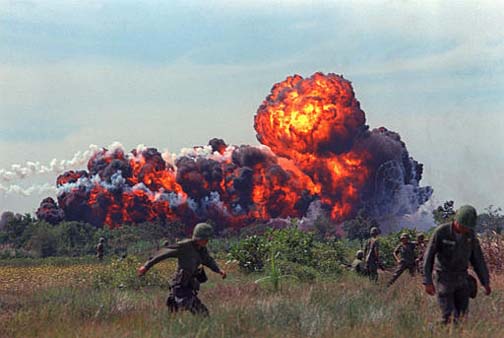
American Citizens are blind to war. This picture represents how we have become immune to war and oblivious to our country's current wars around the world. The blindfolds represent how our citizens do not realize what our military is doing. If the U.S. citizens only knew what our military was doing, it would open our eyes to all its activities. We watch men, women and children die on T.V. almost every night and we became immune to it. In the picture, the American Flag is turned upside down. I believe this represents how upset other countries are with the United States as we try to impose our will. We try to force other countries to be more like us, but in reality, they may not have the will, nor desire, to change. The bones and the blood at the bottom of the picture represent how many millions of people have died in war, and the gray skies above foreshadow that war will continue for years to come. War never seems to have an ending no matter who we are fighting against. The United States has been at war ever since its existence. “The U.S. has never gone a decade without war.” War is never the answer.
Fig 37. Cliff Joseph, My Country, Right or Wrong, 1968

War Is Finding Sereneity In Demise

War Is Finding Serenity In Demise

There is always a beautiful side to war.  It may not be the part where soldiers are shooting one another to survive or throwing grenades at the enemy.  Some say it is the beauty in between the action or even after that.  These photos show the beauty in war outside of death.  Beautiful images of war are never to trick someone into glorifying war.  The tree symbolizes the horrific action that happens in war, but the beautiful outcome of it too.  Such as when a soldier gets to come home after a year or when the country you fought for wins the war.  Many soldiers become desensitized to killing and death but also learn to value life more.  They know that they are always close to death so they cherish their time as much a possible.  The soldier sitting next to the girl is clearly from another country; A country that is full of bad people that the man is trying to kill.  Connecting with this girl and showing her that people like him aren’t bad shows trust and peace in the war.  The little girl is not afraid and neither is the man.  The rendering of Military Funeral Honors is mandated by law. The “honor detail” perform a ceremony that includes the folding and presenting of the American flag to the next of kin and the “Playing of Taps”.  The soldier who had served and been through war is finally at peace.  He or she has been given a proper burial by the men and women they served with.  The Seas of Red at the Tower of London: The poppies encircle this iconic landmark, creating a spectacular display visible from all around the tower but also is held at a location for personal reflection. The Poppies are intended to reflect the magnitude of such an important centenary and create a powerful visual commemoration for all the soldiers who have died in World War One.  All of the poppies that made up the installation were sold. This raised millions of pounds which were shared equally amongst six service charities.  Having such a beautiful landmark for the soldiers who have passed and their families shows the beauty in their bravery and their unforgotten deaths.  
MCCS Military Funeral Honors." MCCS Forward. N.p., n.d. Web.
Vincent, Alice. "Tower of London Poppies to Go on Tour." The Telegraph. Telegraph Media Group, n.d. Web. 22 Mar. 2016.
"ProgressiveChristianity.org : Imagine, Emmanuel Kelly on The X Factor."ProgressiveChristianityorg RSS. N.p., n.d. Web. 22 Mar. 2016.

War is paradoxical; it is something we ravish and cry at the sight of


War is one of the most difficult things in the world to describe. As you can see in this painting, there are four or five soldiers surrounding a dead body. One of the soldiers is pointing a gun into the mouth of the victim. The victim also looks tortured and brutally killed. It is truly horrifying, but what the scariest part is that it is hard to tell whether the soldiers are laughing or crying. This is a paradox. A paradox is defined as something self contradictory. This is a paradox because these men look as if they are both crying and laughing at the sight of this tortured corpse. The artist intending this because they are trying to show that war contradicts itself because it is both the scariest and the most enjoyable thing in the world. It is both scary yet enjoyable because although many people are dying, war is also beautiful. Vietnam Veteran Tim O’Brien writes in his novel, The Things They Carried, “You admire the fluid symmetries of troops on the move, the harmonies of sound and shape and proportion … Any battle or bombing or raid or artillery barrage has the aesthetic purity of absolute moral indifference—a powerful, implacable beauty—and a true war story will tell the truth about this, though the truth is ugly.” (85-86). The beauty of war is that partially that it is not experienced by many people, and it happens so fast. It is one of the most beautiful things in the world but you only are able yo see its beauty if you experience war as a whole. Although it comes with beauty, it is still one of the most brutal experiences. This relates to this painting because it is a truly brutal experience but they soldiers are also seen laughing. The painting shows the soldiers seeing both seeing the beauty and horrors of war. It cannot be differentiated which supports the statement made by the artist that you cannot only see one side. You have to see both sides to truly understand war. This is what makes war paradoxical. You have to see both sides but the two sides of war are contradictory to each other. It is something that cannot be understood by many, which separates war from everything else in the world.
Smagon, Herbert. Occupation of the City Roessel, East Prussia, 1945. Digital image. Imgur.com. N.p., n.d. Web. <http://imgur.com/a/iVrgH>.